
3. Project Management
3.1 Introduction
This chapter covers the project activities and deliverables necessary for overall SRO project management, and adheres to the 2004 Survey Research Operations Standards.
Following are mandatory and conditional project management deliverables for SRO data collection and developmental projects:
 Deliverables
- Project charter;
- Project review summaries (project initiation, interim, closing);
- Scope statement;
- Project management plan;
- Project kickoff meeting;
- Requests for change to the project management plan or work scope;
- Cost reports;
- SRO monthly project reports;
- Client reports;
- Deliverables sign-off;
- Final summary reports;
- Project master file(s); and
- Project close-out checklist.
 Deliverables
- Institutional Review Board (IRB) approval, if the project includes human subjects research;
- NIH certificate of confidentiality, if the research involves sensitive information; and
- Progress reports and charts, if the project includes data collection.
The processes outlined in this chapter may apply equally well and be tailored to large and small, simple and complex, and data collection and developmental projects. Figure 3.1 provides a diagram of project management processes: project initiation, planning, implementation, and closeout, each with a set of project management activities. Initiation precedes planning to start a project, planning is progressively elaborated throughout project implementation, and closeout follows implementation to end a project. Throughout the project lifecycle, there are monitoring and controlling processes, tools, and activities that assure that project time, cost, scope, and quality requirements are met.
SRO best practices for project management are described in greater depth in Sections 3.2 through 3.5. The chapter closes with references.
Figure 3.1 Project Management Processes

3.2 Project Initiation
The project initiation phase generally includes but is not limited to the following:
3.2.1 Receive funding notification
There are several avenues through which SRO might hear that funding has been awarded. Two common ways are receiving notice directly from the sponsor or from a Principal Investigator (PI), or receiving a Project Award Notice (PAN). Once funding notification occurs, the SRO Technical Proposal Coordinator sends an email to the SRO Administrative Group and to the Financial Services Group Director.
3.2.2 Assign key project staff
The SRO Administrative Group will assign a Senior Project Advisor (SPA) and a Project Leader to the project. The SPA’s responsibilities may include:
- Serve as an advisor to the project management team and liaison to the SRO Administrative Group;
- Assist in the allocation of SRO resources to the project;
- Assist the Project Leader, client, and project team in meeting SRO project requirements and resolving problems;
- Identify, highlight, and assist in the resolution of issues faced by a project when those issues have broader implications for SRO;
- Ensure standardization of processes across SRO projects;
- Approve the project charter and the project management plan;
- Review and approve the monthly cost report prepared by the project team before it is delivered to the client;
- Review and provide timely feedback on all formal deliverables to the project client; and
- Seek feedback from the research or client team regarding SRO performance and provide input to the Project Leader.
The SPA will charge a limited amount of time directly to the project.
The Project Leader will:
- Retain final responsibility for the successful execution of the project (to include planning, financial performance, schedule adherence, daily operations, etc.); and
- Arrange for regular updates to the SPA on progress and issues.
The Financial Services Group Director will assign a Financial Analyst to the project.
The Technical Services Group will assign a Technical Leader for systems and instrument development.
The Data Collections Operations Group will assign a Production Manager.
3.2.3 Gather existing project information
The SRO Project Leader should obtain copies from the SRO Technical and Financial Proposal Coordinators of the proposal and budget background materials and a copy of the Project Award Notice (PAN) or Project Award Change (PAC) to confirm the awarded amount.
3.2.4 Create project names
The Project Leader and the Financial Analyst will create project names, including an official project title agreed upon by the PI and the SPA, SRO study name(s), and clear short names for use in systems such as timekeeping and sample management. The Project Leader is responsible for ensuring that names are correctly and consistently used throughout the project. They will also create the project accounts Work Breakdown Structure (WBS) that reflects the relevant 11 budget tasks:
01 Management
02 Sampling
03 Questionnaire Development
04 Instrument Development
05 Systems Development
06 Recruitment and Hiring
07 Training
08 Data Collection
09 Post Collection Processing
10 Weighting
11 Final Deliverables
3.2.5 Develop and obtain approval of the project charter
A charter formally recognizes and authorizes the project and demonstrates management support for the project and for the Project Leader. The Project Leader is usually responsible for drafting the charter. The project charter is officially approved by the SPA, as the SRO Administrative Group representative, before SRO work begins.
3.2.6 Meet with the Senior Project Advisor
As the charter is being developed, the Project Leader should meet with the SPA to review the charter, schedule a project review meeting with the SRO Administrative Group, and agree on the SPA’s role, communication needs for the project, and any risk management requirements.
All projects involve risk of some type. Key risk areas should be identified and plans outlined for response to risk events. Major risk categories are: (1) scope, (2) time, (3) cost, (4) quality, and (5) resources. Some projects may have additional risk categories. See Section 3.3 for further discussion about developing a risk management plan.
3.2.7 Obtain Institutional Review Board (IRB) approval
Before work on a data collection project can start, IRB approval much be obtained. The Principal Investigator (PI) is responsible for obtaining IRB approval. SRO project management staff may assist in this activity by writing or providing the Principal Investigator with text describing standard or study-specific SRO procedures for data collection activities to be used on the project. The IRB Text directory can be found here: L:\projects\IRB Text.
The Project Leader is responsible for obtaining a copy of the IRB submission and any subsequent modifications. The Project Leader must also obtain notifications of IRB approval, and give copies of the IRB approvals to the Research Secretary in the Project Design and Management Group (PDMG).
Following are Web Sites relevant to human subjects research, Program for Education and Evaluation in Responsible Research Scholarship (PEERRS) certification (required for all staff), and IRB application procedures.
3.2.8 Complete the Financial Services project initiation process
Before work begins, SRO Financial Services will set up project accounts. The Project Leader will meet with the Financial Analyst assigned to the project to determine the appropriate account structure for the project. Figures 1 through 3 in Financial Services Flowcharts show Financial Services activities as they relate to project initiation.
3.2.9 Set up the network location for project files
The Project Leader will set up a project folder on L:\Projects on the SRO network. Subfolders reflect the relevant ten budget tasks, with project-specific subfolders under the 11 budget work breakdown structure tasks (see the Project Charter Template), for example:

An empty Model Project Directory can be found here: L:\projects\Model Project Directory.
3.2.10 Monitor and control project initiation
Project initiation activities are primarily monitored and controlled through the Project Leader’s coordination with the principal investigator on work scope, the development of the project charter, meetings the Project Leader has with the SPA and the Financial Analyst, and the project initiation meeting with the SRO Operations Team.
3.3 Project Planning
3.3.1 Hold an initial project review meeting
Project review meetings occur at the initiation and closing of the project, as well as one or more times during implementation, depending on the duration or complexity of the project and risks and challenges that arise. The Project Leader will schedule the first project review meeting when the project planning phase begins. The Project Leader will complete the first report based largely on materials generated during proposal development.
The purpose of the project review is to keep the SRO Operations Team informed so they can understand the project’s status as well as issues and risks faced by the project. Topics include: implementation plans for new projects; status updates; special concerns and risks; and responsive design plans. The first session held for a project is called the project initiation meeting. At this initial meeting, the project charter is discussed, and the use of SRO resources is authorized.
Project reviews generally last 30 minutes, but may be extended as needed. Project managers should schedule a review at the following key points:
- Within one month of the funding award;
- Immediately before data collection begins, if relevant;
- Once during the implementation period, with additional meetings scheduled for difficult, high risk, or protracted projects;
- At the conclusion of data collection, if relevant; and
- When the project closes.
To schedule project reviews, Project Leaders should look at the project review schedule on the SRO Intranet Project Management page to see what date and time slots are available. Then the Project Leader should view and schedule a project review with the PDMG Research Secretary, who will request the project review materials for distribution approximately four days prior to the review meeting.
Project Management Review Meeting Schedule (requires authentication)
Project Management Review Summary Template
3.3.2 Set up the Cost Reporting System
If not done during project initiation, the Financial Analyst will enter the approved budget into CRS at this time.
Cost Reporting System Manual (requires authentication)
Cost Reporting System Template (requires authentication)
3.3.3 Set up the Monthly Project Reports
If not done during project initiation, the Project Leader will enter initial project information, including project identifiers and description, client information, team members, periods of performance, and budget into the MPR system at this time.
Monthly Project Report System (requires authentication)
3.3.4 Create cost projections
The SRO Project Leader, working with the Financial Analyst, will create projections for each line item in the budget, detailing the estimated expenditures for that line item for each month during the project period. The Project Leader should seek input from task leaders, or team members, on the level of effort required to complete the tasks assigned to them. This ensures that the cost estimates are realistic and could inform discussions regarding work scope.
3.3.5 Assemble a project team
Very few projects can be done by just one or two people. Most projects require input from multiple functional groups within and outside of SRO. The Project Leader will create a staffing management plan that lists the resources needed for the project and the timetable for resource needs. Based on this information, the SRO Operations team and functional group managers will assign staff members to the project.
3.3.6 Develop the project management plan
This process defines and coordinates all subsidiary plans into a project management plan—a description of how the work will be conducted. The project management plan is the primary source of information for planning, executing, monitoring, controlling, and closing the project. Creation of the management plan is an iterative process. The Project Leader will create the initial outline, and project team members may contribute to development of the written management plan. Project team members should be involved in much of the project’s planning and decision making.
Project Management Plan Template
Elements of the project management plan should include:
- Scope Statement – A scope statement is a description of what work will be conducted for the project and the project deliverables. The scope statement is developed from information in the Project Charter, the proposal, and the budget justification documents.
Project Scope Statement Template
- Project Schedule – All projects must have a written project schedule. The schedule can begin as a general outline with major milestones. Schedule development continues throughout the project as work progresses. Changes to the schedule must be documented and tracked. While there are templates for documenting the project schedule and timeline, the project team will determine the format and level of detail required in each.
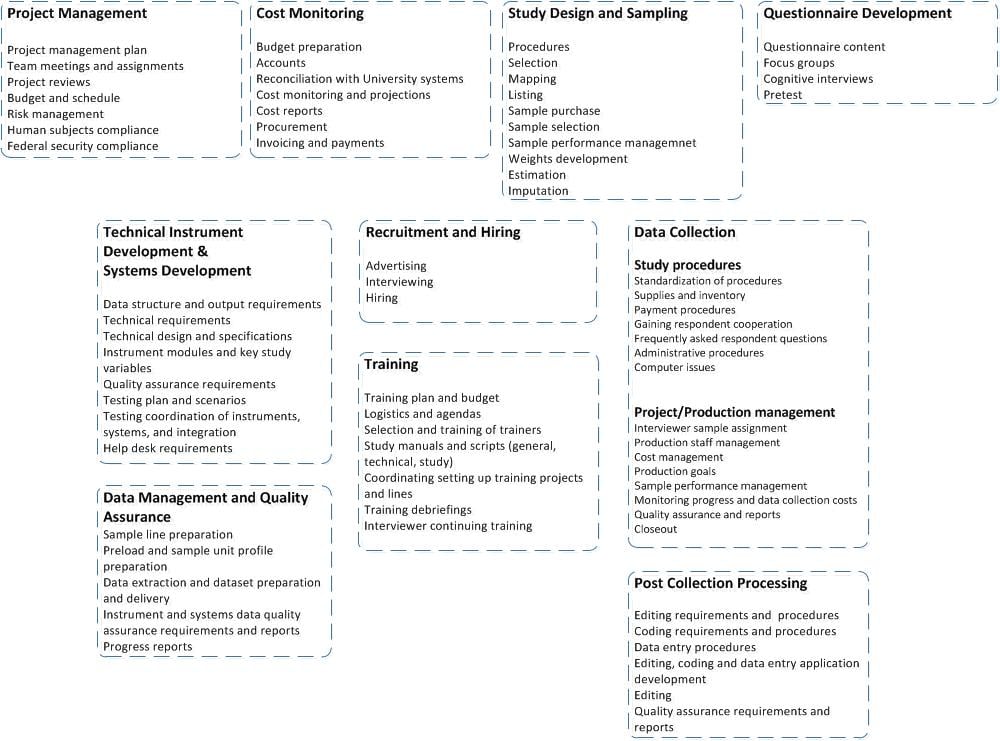
- Resource Management Plan – The resource management plan outlines the project’s team roles and resource requirements. It includes a resource allocation map that lists leaders in each area, the team members (resources), projected number of hours for each, and details the project accounts to be charged for their time. The map is a summary of the work done by the Project Leader to estimate projections for each resource line item in the baseline budget, in relation to general areas of responsibility. Figure 3.2 shows project management major areas of responsibility and the Resource Management Plan Template shows the relation of these areas to the 11 budget WBS tasks.Resource management also involves identification of one or more Project Technical Leaders, based on the complexity of the project and the extent of the use of SRO systems and the use of new technology. Generally technical leaders focus on sample management systems, computer assisted and Web survey instrument development, and data management systems—and their integration across pre-production, data collection, user support, and post processing.
Resource Management Plan Template
Technical Leader Description
Figure 3.2 Major Areas of Responsibility
- Communication Plan – A communication plan documents the information needs and the communication needs of the project stakeholders. At a minimum, the communication plan should include:
1. Team member responsible for communication;
2. Information to communicate;
3. Stakeholders or audience;
4. Method of communication; and
5. Frequency of communication.
Communication Management Plan Template
- Risk Management Plan – All projects involve risk of some type. The risk management plan defines the risk mitigation strategies throughout the project lifecycle in relation to the project schedule, budget, and quality of deliverables, as well as to SRO and the Center. Key risk areas should be identified and plans outlined for response to risk events. Major risk categories are: (1) scope, (2) time, (3) cost, (4) quality, and (5) resources. Some projects may have additional risk categories. The risk management plan also includes a risk register, which lists risks identified and actions taken throughout the project lifecycle.Table 3.1 shows an example of a risk breakdown structure (RBS) that can facilitate identifying a specific project’s area of risk. This table shows four areas of risk: technical, project management, business, and external, with examples of each type. For example, a project may have ill-defined work scope, which this table categorizes as a technical risk.
Table 3.1 Example of a Risk Breakdown Structure (adapted from Hillson and Simon 2007)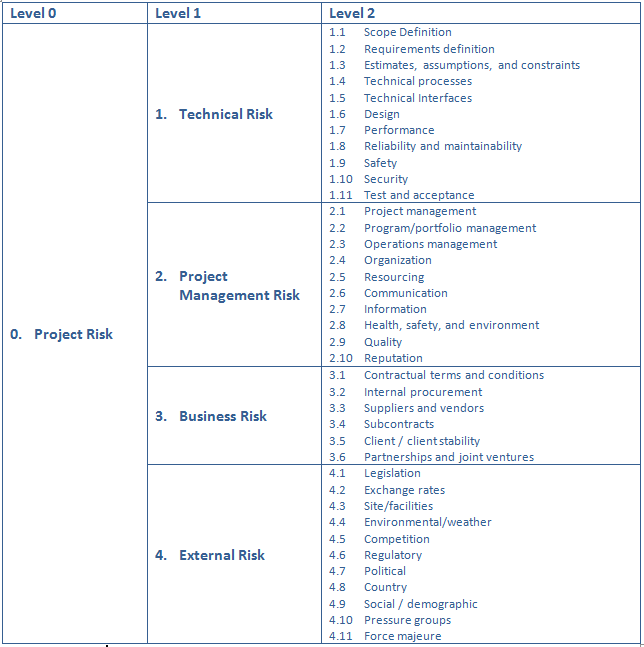
- Cost Management Plan – This plan contains a copy of the project budget and the account structure. Cost management processes to be used for the project and the staff responsible for these processes should be documented. Any changes to the budget during the course of the project should be documented in the project management plan.
- Quality Management Plan – This plan documents the processes and procedures used to ensure that the project deliverables meet both project requirements and SRO standards. Ideally, this plan will be created by a subset of the project team directly involved in quality assurance.
- Procurement Management Plan, if applicable. The procurement management plan describes how the project team will determine what to acquire (e.g., materials, equipment, or external resources), based on project and product requirements, as well as the contractual methods that will be used for procurement. Not all projects involve procurement. The procurement plan should be discussed with SRO Financial Services (contact the Financial Analyst).
3.3.7 Obtain a Certificate of Confidentiality
An NIH certificate of confidentiality may be required if the research involves sensitive information. Information is considered sensitive if its disclosure could have adverse consequences for subjects or damage their financial standing, employability, insurability, or reputation. The PI is responsible for applying for the certificate of confidentiality when warranted.
NIH Certificate of Confidentiality Kiosk
3.3.8 Monitor and control project planning
The project management and subsidiary plans are progressively elaborated throughout project implementation, as new risks are identified, scope changes, and quality management activities identify areas that require process improvement.
3.4 Project Implementation
Key aspects of project implementation and control include project team coordination, financial monitoring and management, reporting, and obtaining approval for changes in scope of work or project procedures and materials.
3.4.1 Coordinate the project team
Activities for project team coordination should include, but are not limited to:
Schedule a kickoff meeting
Every project will have a kickoff meeting, to be held after the project charter has been approved and before significant project work begins.
The first step in implementation is contacting project team members to schedule a kickoff meeting. For projects with multiple phases, the Project Leader may determine that multiple kickoff meetings, related to the key phases of the project, are needed. The Project Leader is responsible for inviting all SRO stakeholders to the kickoff meeting(s). A representative from each functional group involved in the project should be present. The Project Leader should also check with department heads to determine whether any additional staff should be invited to the kickoff meeting(s). In many cases, the Principal Investigator(s) may also be invited to attend.
Before the initial kickoff meeting, the Project Leader will prepare a packet of materials, approved by the SPA, for those attending the kickoff meeting(s). This packet may include the project scope statement, a draft schedule, the project management plan outline, and drafts of the communication plan, the risk management plan (including risk analysis worksheets as appropriate), and the quality assurance plan. The Project Leader will provide participants at the kickoff meeting with project account numbers for charging their time.
The kickoff meeting agenda may include the following:
- Discussion of the work scope and objectives of the project;
- Definition of roles and responsibilities;
- Project schedule;
- Resource allocations;
- Budget and cost projections;
- Team assignments for development of the project plan; and
- Scheduling of regular team meetings.
Project Kickoff Meeting Template
SRO Meeting Process: Guidelines & Norms
Obtain approval of deliverables and to proceed
After the project details are elaborated and documented in the project management plan, the PI and the SPA must sign off on the final study design and deliverables. These usually include a written signoff on key deliverables such as the project management plan, sample design, questionnaire, and report formats.
Implement the project management plan and manage the project
These are ongoing tasks throughout the project. Activities are used to provide control and quality assurance for the project, to establish project reporting requirements and milestones, and to provide for project administration. Project management activities should be referenced and evaluated against the project plan, and the plan should be modified if necessary.
Obtain approval of major changes to the project management plan
The PI and the SPA should sign off on all significant changes to the project plan (as well as changes in scope).
Planning is ongoing throughout the life of a project. Project teams need regularly-scheduled team meetings to enhance communication and to track team performance against the management plan. Purposes of team meetings include:
- Monitoring progress of the project;
- Resolving outstanding issues or questions;
- Resolving resource conflicts;
- Continuing development of the project plan;
- Communicating and coordinating changes; and
- Providing feedback to the team.
Project Plan or Work Scope Change Request Template
See Section 3.4.4 for additional information on submitting change requests.
3.4.2 Monitor and manage finances
Activities for this task could include, but are not limited to:
Monitor expenses
The SRO SPA and the Financial Analyst are responsible for monitoring project expenses and cost projections. The Financial Analyst enters and updates the cost projections using the CRS.
Cost Reporting System Manual (requires authentication)
Cost Reporting System Template (requires authentication)
Estimate costs
Projections will reflect the best estimate of actual costs. The Project Leader should seek input from the task leaders or team members on the level of effort required to complete the tasks for which they are responsible. In addition, the Financial Analyst and Project Leader should analyze costs from prior waves of the project as appropriate, or of projects/tasks with similar scope to inform the cost projection process. This ensures that the cost estimates are realistic, and if not, might result in discussions regarding work scope.
Create and review updated cost reports
Each month, when CRS is updated with actual cost information for the prior month, the Financial Analyst will create an updated cost report for the project. The SRO Project Leader will review and discuss the projections with the Financial Analyst and will make any updates needed.
Produce cost reports at least monthly
Monthly cost reports are the minimum requirement for any project. The frequency of reporting for each project will be discussed with the PI.
Review and obtain approval of cost reports
The SPA will review and approve differences between approved funding and projected expenses each month. The SPA will sign off on the cost report before it is sent to the client.
Figures 4 and 5 in Financial Services Flowcharts show Financial Services activities as they relate to project management implementation.
3.4.3 Report on project status
Activities for this task could include, but are not limited to:
Schedule Project reviews
The project review provides key senior SRO management staff with an understanding of the status of the project as well as the issues and risks faced by the projects and SRO. The Project Leader should schedule one or more project reviews during the implementation phase of the project.
Project team representatives at the management review generally include the Project Leader(s) and the Financial Analyst. They may invite additional attendees as appropriate. The project plan should be brought to the meeting and is used to provide the basis of the report to the SRO Administrative Group. See Section 3.3 for additional information on scheduling project reviews.
Project Management Review Summary Template
Project Management Review Schedule
Submit Monthly Project Reports
The Project Leader is responsible for creating the monthly project report (MPR) summarizing the status of the project, including performance statistics and any items of special interest or cause for concern.
Generate Progress Reports
SRO will generate performance statistics, cost and productivity measures for project monitoring on a daily basis, and laid out in the Quality Management Plan. These data will be made available to the project team and the PI.
Clients need to be informed on a regular basis about the progress of the project. The Project Leader should create a formal, written report for the client on an agreed upon schedule.
Example of Monthly Client Report
3.4.4 Request approval of changes in scope of work
Throughout the execution of projects, the scope of work agreed upon by SRO and the funding agency and research investigator will often change. Changes may range from an increase or decrease in the response rate to the deletion of an entire task to a significant change in field procedures. To ensure that the necessary resources are available to handle scope changes, the project team will need confirmation from the SRO Administrative Group that changes are formally accepted and approved for implementation.
All scope change requests will include:
- A change description;
- The reason for change;
- The impact on the schedule;
- The impact on resources; and
- The impact on the budget.
Changes that may affect cost, schedule, and any other agreements must be approved in writing by the client and by the SRO Administrative Group. To make certain that the necessary resources are available to handle scope changes, the project team will need to seek confirmation from the SRO Administrative Group that this is formally agreed to and approved for implementation.
The Project Leader should send an email with an attached work scope change request to the SRO Administrative Group with a carbon copy to the SRO Operations Team. The e-mail provides a brief description of the proposed change. The request will be discussed at the next administrative group meeting and the SPA will respond formally to the request. A copy of an approval signed by the SPA should be added to the project management plan, and noted in the monthly report.
Project Plan or Work Scope Change Request Template
3.4.5 Obtain IRB approval of changes in procedures and materials
Any change in data collection procedures or materials must be approved by all appropriate Institutional Review Boards before being implemented. IRB approvals must be reviewed and re-approved annually. The Project Leader will obtain electronic copies of all IRB submissions (including modifications) and approvals, as well as documentation of procedures and materials submitted for approval.
Health and Behavioral Sciences IRB Application Procedures and Templates
Medical School IRB Standard Operating Procedures
SRO IRB Research Process Guidelines
3.4.6 Monitor and control project implementation
The Project Leader and the team members are responsible for evaluating the project procedures, goals, milestones, and deliverables throughout all phases of a project. The Project Leader and the team members together develop information on viable alternatives used to meet the defined requirements and objectives.
For data collection projects, the use of responsive design is encouraged. Decision points are identified in the project management plan, along with proposed design alternatives. Throughout the project period, data are collected and evaluated, and adjustments are made to ensure optimal cost-error tradeoffs for the project.
3.5 Project Closeout
Every project must be formally closed and documented. Activities for this task could include, but are not limited to:
3.5.1 Complete the project deliverables sign-off form
This ensures that all agreed-upon products and reports have been delivered, and approved by the Principal Investigator and SRO SPA.
3.5.2 Complete the project closeout checklist
Complete the project closeout checklist to ensure that all closeout activities have taken place. Figure 6 in Financial Services Flowcharts shows Financial Services activities related to project closeout.
3.5.3 Hold a project team debriefing
The project team should meet to debrief, reflect on the study, and complete a “lessons learned” report for the final project summary.
3.5.4 Write final summary report
A final summary report should be prepared, including methods used and lessons learned. The final report serves as a history of the study from inception and design to data collection and analysis. They include updated copies of the project management plan and subsidiary plans and documents, copies of any paper materials used for the project, a finalized Field Progress Report, cost reports, and any other significant project materials. In addition, this provides a detailed account of issues related to data protection, respondent confidentiality, or professional codes, as well as proposed solutions (see Section 12.2 for a more detailed description of summary reports).
3.5.5 Hold a project review meeting
The Project Leader will schedule the final project review meeting when the project ends.
3.5.6 Assemble project materials for archiving
Assemble all final versions of project materials, preferably in electronic form and arrange for storage of hard copy documents. These are needed for Project Archiving (see Chapter 12) and for creating a master file for the project.
3.5.7 Monitor and control project closing
The Project Leader ensures that all activities as outlined in this section have been completed according to best practices.
3.6 References
Cook, C.R. 2004. Just Enough Project Management. NY: McGraw-Hill.
Hillson, D., and P. Simon. 2007. Practical Project Risk Management: The ATOM Methodology. Vienna, VA: Management Concepts, Inc.
Office of Management and Budget. 2006. OMB Standards and Guidelines for Statistical Surveys
Project Management Institute. 2008. A Guide to the Project Management Body of Knowledge (PMBOK® Guide). Newtown, PA: Project Management Institute, Inc.
The Stationary Office. 2009. Directing Successful Projects with PRINCE2™. Norwich, UK: TSO.